
How to Build Service Area Pages for Local SEO That Customers Actually Use
Many local businesses serve more than one community, but their websites do not always explain that coverage clearly. A visitor may know the company name but still wonder whether the business works in their neighborhood, how far it travels, and whether it understands local needs.
Service area pages for local SEO can help organize that information. When planned carefully, they give customers a clearer path and give search engines more context about the markets a business genuinely serves. The goal is not to publish a page for every nearby ZIP code. The goal is to create useful local resources that support visibility and conversion.
This guide explains how to decide which pages deserve to exist, what each page should include, and how to avoid the thin, repetitive content that makes a location-focused website feel untrustworthy.
- A service area page explains the relationship between a business, its services, and a specific community.
- It should answer local customer questions instead of repeating a generic service description.
- The page should make the next step—calling, requesting a quote, booking, or visiting—easy.
Choose Locations Based on Real Business Coverage
Start with the business itself, not a keyword spreadsheet. List the communities the company currently serves, the areas it wants to develop, and the places where travel, scheduling, licensing, weather, housing, or commercial conditions may affect the work.
For example, a residential contractor may serve several North Texas communities but face different customer questions in established neighborhoods, newer developments, and fast-growing suburbs. A commercial service provider may need to explain travel coverage, response expectations, building types, or scheduling considerations.
A location deserves its own page when the company can add meaningful detail. If the only difference between two drafts is the city name, combine the information into a broader service-area page rather than publishing duplicate versions.
- The business regularly serves the location.
- The location is part of the company’s real growth plan.
- Customers ask location-specific questions.
- The business can provide useful, original information about serving that market.
- The page supports a clear service or conversion path.
What to Include on a Strong Location-Focused Page
A useful page should feel like a local explanation of the service—not a lightly edited national template. Begin with a direct introduction: identify the business, the service, and the community served. Then explain what customers can expect before, during, and after contacting the business.
Add local context only when it is relevant. That might include property types, seasonal conditions, common project considerations, service boundaries, or the neighborhoods and nearby communities the business routinely reaches. Avoid making unsupported claims about local demand, competition, or customer behavior.
Each page should also have a practical next step. A visitor looking for a service in Plano or Fort Worth should not have to return to the homepage to figure out how to request help. Use a visible phone number, form, booking option, or consultation link that matches the business’s actual process.
- A specific service offered in the area.
- The types of customers or properties served.
- Local factors that affect the work.
- Common questions about scheduling, access, timing, or preparation.
- A clear call to action for that location.
- Relevant internal links to the main service page, related services, and contact page.
Connect Service Area Pages to the Rest of the Website
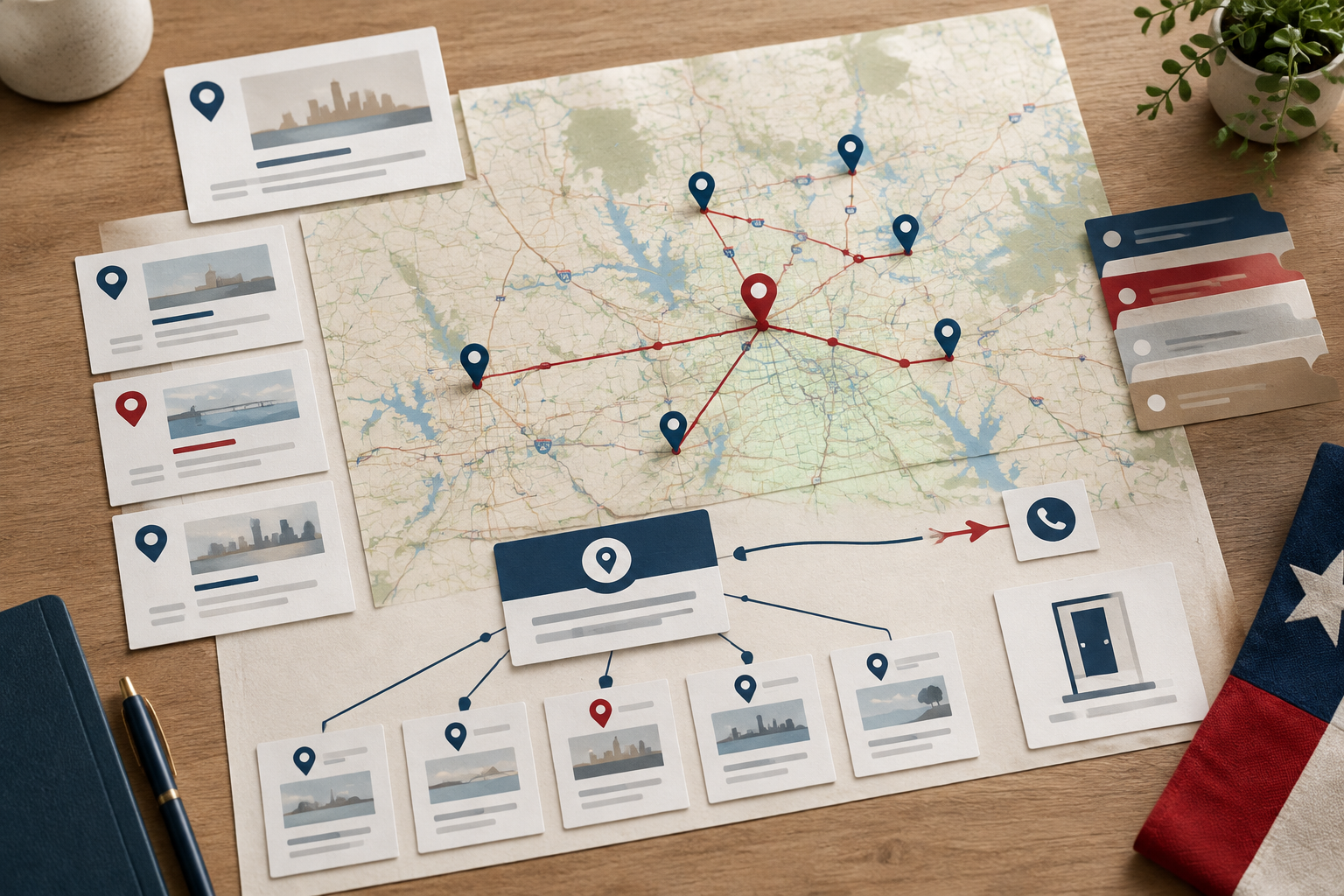
Website structure matters because customers and search engines need to understand how pages relate to one another. A service-area hub can summarize coverage and link to individual location pages. A core service page can link to the locations where that service is available. This creates a logical path from broad information to a specific local decision.
Keep URLs, titles, headings, and internal links consistent. The page title should describe the actual service and location without awkward repetition. For instance, a page about residential electrical work in a specific community should not use a title that lists every nearby city.
If the business has a physical location, make sure local business information is accurate across the website and relevant profiles. If it is a service-area business without a public storefront, describe the service model honestly instead of implying a walk-in location.
- Use a clear URL structure, such as /service-area/location/ or /locations/location/.
- Link from the main service page and a central service-area hub.
- Use one descriptive page title and one clear H1.
- Write a specific meta description that accurately reflects the page.
- Use consistent business name, address, phone, and service information where applicable.
- Add relevant internal links rather than forcing every page to link to every other page.
Avoid Thin, Duplicated, and Over-Optimized City Pages
Thin location pages can create more problems than they solve. A page with a few generic sentences, a repeated service list, and a form may technically mention a city, but it does not help a customer make a decision. It also gives the website a repetitive, low-value appearance.
Do not use local references as decoration. If a business cannot explain why the location matters to its service, a broader page may be the better choice. Likewise, avoid creating pages for every place within driving distance simply because those names have search volume.
A careful content audit can reveal overlap. Review page titles, primary services, target locations, calls to action, and the actual information on each page. Consolidate pages when they compete with one another or provide no distinct value.
- Changing only the city name in a standard template.
- Listing neighborhoods with no explanation of services or coverage.
- Creating pages for locations the business does not actually serve.
- Making unsupported claims about being the best, fastest, or most experienced.
- Adding long city lists that make the page difficult to read.
- Using multiple pages that target the same service and location with slightly different wording.
Maintain and Improve the Pages Over Time
Launching a page is only the beginning. Local businesses change: service areas expand, technicians move, hours shift, and certain services may become unavailable. A quarterly or semiannual review can help keep location content aligned with operations.
Performance review should include both visibility and customer behavior. Search impressions may show that a page is being discovered, but calls, form submissions, and qualified inquiries reveal whether the page is useful. If visitors reach a page but do not take action, review the offer, trust signals, clarity, mobile layout, and contact process.
For a business serving Dallas-Fort Worth or other parts of Texas, the best structure may include a small number of carefully developed community pages rather than an oversized network. The right choice depends on actual coverage, resources, and the questions customers need answered.
- Review the service list and confirm that each location page reflects current availability.
- Check that phone numbers, forms, hours, and booking links work.
- Compare the page with the business’s Google Business Profile and other local listings.
- Look for duplicate titles, headings, paragraphs, and location claims.
- Track meaningful actions such as calls, form submissions, quote requests, or bookings—not rankings alone.
- Update pages when service boundaries, locations, or customer questions change.
A Better Standard for Local Service Pages
Service area pages are most valuable when they bring together three things: truthful coverage, helpful local information, and a clear customer journey. They should support the business’s broader website strategy, not exist as isolated keyword targets.
Before publishing, ask whether the page would help someone decide to contact the business. If the answer is no, improve the substance or reconsider whether a separate page is necessary. A smaller website with strong, relevant pages can be easier to maintain and more credible than one filled with repetitive location variations.
Pakdelify can help small businesses plan a service-area website structure, improve local content, connect pages to conversion paths, and maintain the site as services and markets change. If your website serves multiple communities but does not make that coverage clear, schedule a consultation to review the best next step.
- Real service coverage and operational capacity.
- Distinct customer questions by location.
- A clear relationship between the service and the community.
- Original information that cannot be copied from another page.
- A simple, measurable conversion path.
Frequently asked questions
What is a service area page in local SEO?
A service area page is a useful, location-focused page that explains what a business offers in a specific community or service area. It should include locally relevant information, clear services, proof of experience, and an easy next step—not just a city name added to a template.
How many service area pages should a small business create?
Create pages only for locations the business genuinely serves and can discuss meaningfully. A smaller set of complete, helpful pages is usually more useful than a large group of nearly identical pages.
Are service area pages different from city pages?
The terms are often used interchangeably, but a strong page should do more than target a city keyword. It should connect the business’s services to the needs, conditions, and customer questions of that local market.
Can service area pages help a business rank in nearby cities?
They can support local visibility when they provide relevant information and align with the business’s actual service coverage. They do not guarantee rankings, and they work best alongside a well-maintained Google Business Profile, strong website structure, reviews, and other local SEO efforts.
Should every service have a separate page for every location?
Not always. Separate pages are appropriate when customers in different locations have meaningfully different needs or when the business has enough useful information to create a complete page. Otherwise, a strong service page and a clear service-area section may be better.