
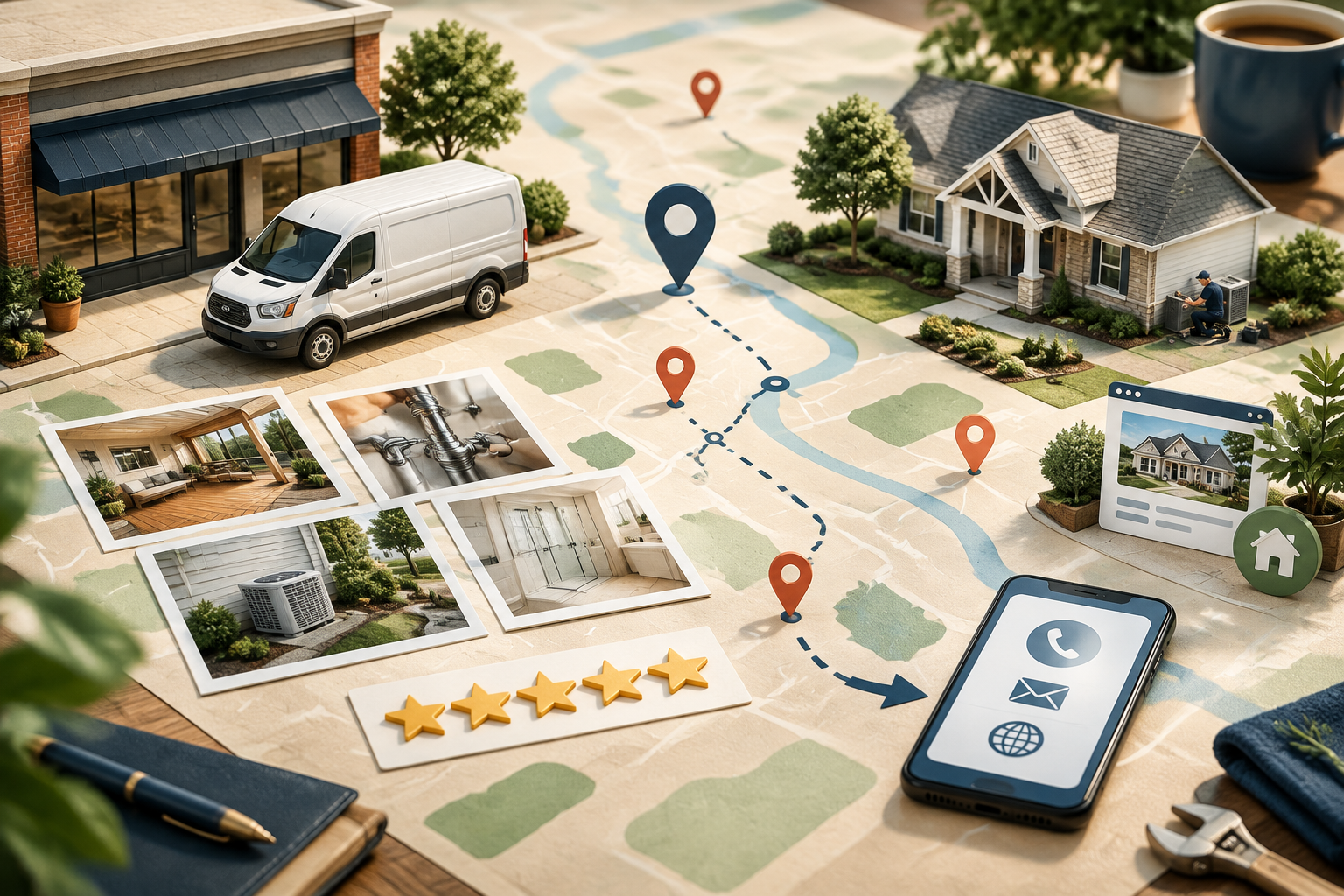
Why your Google Business Profile is a high-value customer touchpoint
For many local service businesses, the first customer interaction does not happen on the website. It happens when someone searches Google Maps for a nearby provider, compares a few listings and decides which business appears trustworthy enough to contact.
That makes your Google Business Profile more than an online directory entry. It is a local decision page. Customers may use it to check whether you serve their area, understand what you do, view photos, read reviews, call your business or visit your website.
Google Business Profile optimization for service businesses focuses on making those decisions easier. The goal is not to add random keywords or promise instant rankings. The goal is to provide accurate, complete and useful information that supports both customer confidence and local search relevance.
What a complete service-business profile should include
A profile can be technically claimed and still be underdeveloped. Missing services, outdated hours or vague descriptions create friction at the exact moment a potential customer is comparing providers.
Start by asking what a first-time customer needs to know before making contact. A residential electrician, mobile detailer, dental office and commercial cleaning company will not need identical profile information. The profile should reflect the way customers actually buy that service.
- A precise business category that reflects the main service
- A complete description written for customers, not just search engines
- Accurate hours, phone number, website link and appointment options
- Clearly defined service areas for businesses that travel to customers
- Specific services with helpful descriptions where available
- Recent, authentic photos that show the business, equipment, work or location
- A process for monitoring and responding to reviews
- Answers to common customer questions when the feature is available
How service-area businesses can communicate location clearly
Service-area businesses face a particular challenge: customers need to know where the business works, but the business may not operate from a public storefront. A profile should communicate the service area accurately without making the business appear to have a customer-facing location that it does not have.
Define the areas you genuinely serve rather than listing every nearby city. A long, unfocused location list can make the profile less credible and may create expectations the business cannot meet. Service areas should match operational capacity, travel patterns and the locations described on the website.
Your website can add useful depth. A service page can explain the work, process, qualifications and service boundaries, while the Business Profile gives searchers a concise local overview. These two assets should reinforce one another without copying the same text everywhere.
A practical maintenance routine
Optimization is not a one-time setup task. Businesses change phone numbers, expand service areas, add offerings, adjust hours and receive new customer feedback. A profile that was accurate last year may now give customers the wrong answer.
Create a simple review routine. Once a month, verify the essential business information, inspect the services, review new customer feedback and check whether the photos still represent the business. Make additional updates whenever an operational change occurs.
- Use the primary category that best describes the core business.
- Add only relevant secondary categories; more is not always better.
- Describe services in plain language customers are likely to understand.
- Use real photos of completed work, tools, vehicles, facilities or team activities when appropriate.
- Keep hours and contact details current, including holiday or appointment information.
- Respond to reviews professionally and specifically rather than using identical replies.
- Check the listing for unauthorized changes, incorrect information or outdated media.
- Use profile updates when there is genuinely useful news, seasonal information or service guidance to share.
Measure usefulness, not just visibility
These questions connect profile optimization to the customer journey. A listing may receive visibility but still produce weak inquiries if the service description is unclear or the next step is difficult to find.
Review quality matters as well. A large number of vague reviews may provide less useful context than detailed feedback that explains what service the customer received and what the experience was like. Businesses should invite honest feedback without scripting or incentivizing reviews improperly.
- Are customers searching for a service you offer but not seeing it clearly in the profile?
- Do your reviews mention the specific qualities you want new customers to understand?
- Are your photos current, recognizable and relevant to the work?
- Does the website link send visitors to the most useful page?
- Do the profile and website describe your service area consistently?
- Are unanswered questions or inaccurate edits creating confusion?
- Can a customer quickly understand what to do next—call, request a quote, book or visit?
Turn your profile into a clearer local customer path
Google Business Profile optimization works best as part of a broader local marketing system. Your profile, website, review process and customer follow-up should tell a consistent story.
Pakdelify can help a small business review its local search foundation, clarify service information, improve the connection between the profile and website, and establish practical ongoing care. For businesses serving customers in Dallas-Fort Worth, elsewhere in Texas or across the United States, the right plan depends on the market, service model and operational priorities.
If your listing is claimed but rarely maintained, start with an accuracy review. Identify the information that could cause a customer to hesitate, then improve the profile in a deliberate order. Clearer local information will not replace good service—but it can help the right customers understand what your business offers and how to take the next step.
Frequently asked questions
What is Google Business Profile optimization for a service business?
It is the process of improving a business’s Google Business Profile so customers can understand its services, service area, availability and credibility. It includes accurate business details, service descriptions, photos, review management, updates and ongoing maintenance.
Can a service-area business use a Google Business Profile without showing its address?
Yes. Businesses that travel to customers can generally configure their profile as service-area businesses and hide a residential or non-customer-facing address. The profile should accurately represent where the business operates and comply with Google’s current guidelines.
How often should a Google Business Profile be updated?
A profile should be reviewed whenever business information changes and checked regularly for inaccurate edits, outdated photos, unanswered reviews, incorrect services or missed customer questions. The right maintenance schedule depends on the business and how frequently its services change.
Does optimizing a Google Business Profile guarantee better rankings?
No. Optimization can make a listing clearer and more useful, but local visibility also depends on factors such as relevance, distance, prominence, competition, website quality, reviews and customer behavior. No ethical provider can guarantee a specific ranking.
Should my website and Google Business Profile use the same service information?
Yes. Your core business name, contact details, services, service areas and hours should be consistent across your website and profile. Consistency helps customers avoid confusion and gives search engines clearer information about the business.